Saturday, August 29, 2009

Women vows to revive millets in farms and food chain


Women’s Traditional Food Festival
Trinjan at village Jida (Bhatinda)
An initiative of Women Action for Ecology
Date: August, 23, 2009

Women vows to revive millets in farms and food chain


Natural farming is a production system that sustains the health of soils, ecosystems and people. It relies on ecological processes, biodiversity’s cycles adapted to local conditions, rather than the use of inputs with adverse effects. Natural farming combines tradition, innovation and science to ensure that we live in partner ship with environment and not to exploit any thing beyond permissible levels so that sustainable development is ensured.

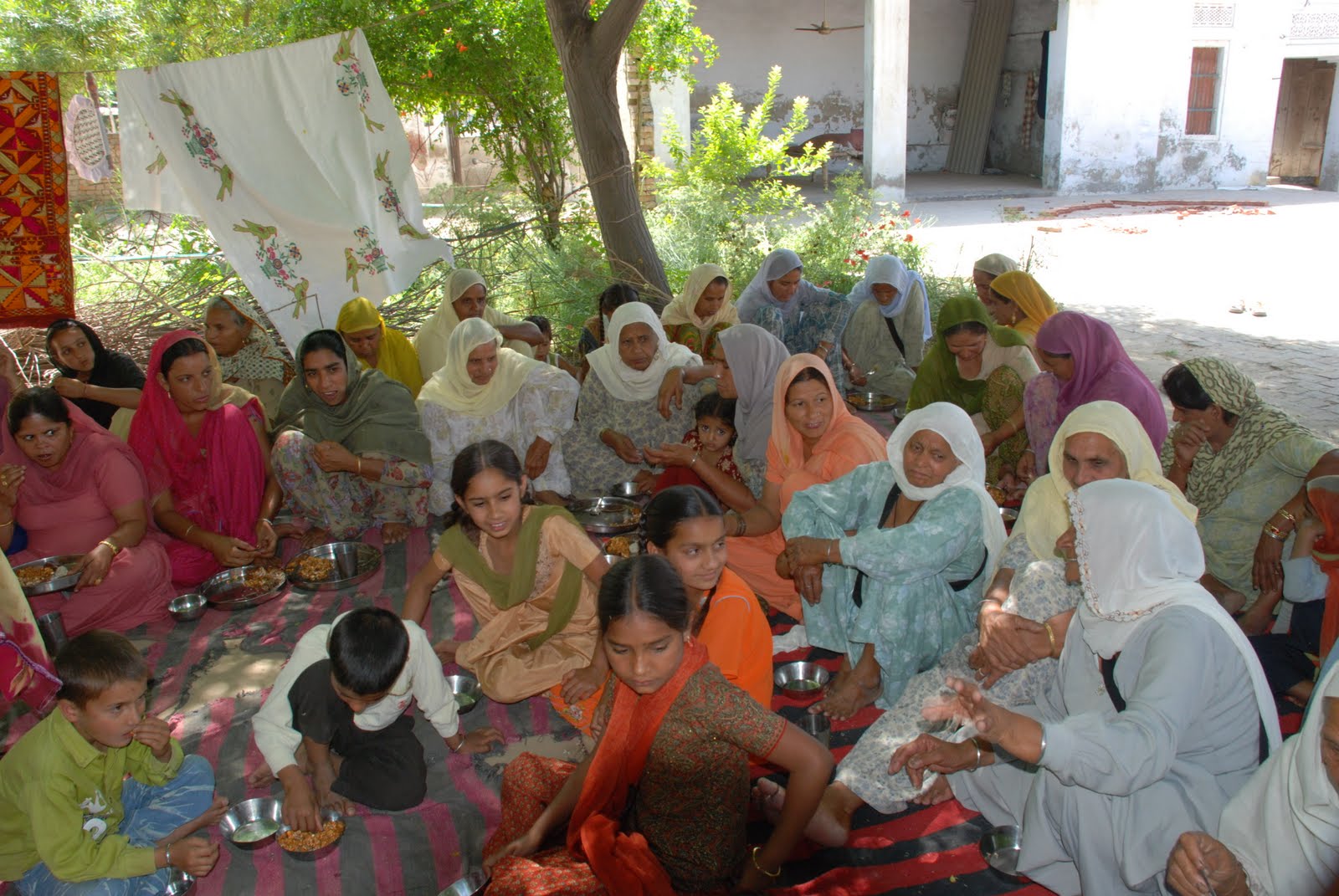
To save and regenerate environment a silent revolution is happening in Punjab ‘Kheti Virasat Mission (KVM). The Women Action for Ecology an associate action group of KVM works in villages to convince farmers about farming without pesticides. In continuation to this process a small gathering at village Jeeda in Bhathinda District on 24th Aug was organized The meeting was hosted by the sarpanch of the village S. Satgur Singh. The farm house of the sarpanch was a perfect venue for such a meeting with a tube well flowing outside his house .The courtyard had a huge canopy of Neem trees under which the meeting was held. More then 150 women and 50 plus children were part of this food festival. Their enthusiasm is a matter of hope to revive ecological agriculture in Punjab. The participation of women is certainly an indicator that sapling sown by KVM’s Women Action for Ecology is taking its roots now.
Mr. Umendra Dutt greeted the meeting of the women of the village .He started by informing them that, DDT and several other deadly pesticides many more poisonous substances are found in the blood samples of the people of Punjab, why is it so? And

To explain this he went back to explain the law of evolution that worms and insects were present on the surface of the earth about 220 million years ago where as man is a very new member of this planet. The man came into existence roughly 10 million year ago, he further said that till a few decades back no artificial fertilizers or pesticides or insecticides were used but earth produced enough food to support life on it, since the time man has started using pesticide sprays etc, he has started giving poisonous food to his family.

He asked the ladies, whether they can serve poison laden food to their family to which all answered in negative, so he gave the example of certain pests and said that they also lay eggs away from the place where they sense danger and what are we human doing? He explained the process how Moth lays eggs and how worms are formed. He said earlier only one spray of pesticide was enough for a crop but not people have to spray 5 – 6 times and still pests are not killed this is because they have developed resistance from it.

He motivated the women to at least start with small portion of land where they should grow vegetables and cereals for home consumption and it should be grown without fertilizers and pesticides, another volunteer of KVM explained how to prepare Jeevan amrit (a cow urine based microbial preparation) to revive microbial activity in soil.

Gurpreet Singh explained that first of all plough the piece of land, add organic fertilizer that is cow dung etc to it and mix it well and level it then water it and leave it for a few days it can be covered by leaves etc. After a few days sow the seed and prepare Jeev Amrit which is made by putting together Jaggry, Besan, cowdung, cow urine, mix it all in 25 litres water and leave it for 2 – 4 days, after it is ready spray it in the field along with water and stop this practice once the plant bears fruit or flowers.

Another remedy was that 7-8 days old buttermilk can be sprayed on the crops to protect plants from ants and worms. He also told how we can make spray out of Neem leaves and fruit by grinding and mixing it with cow’s urine and leaving it for a few days and then spraying it in the crop.

Gurpreet Singh explained that planting the same crop at the same time year after year allows a build up of weeds. Switching crops and planting times keeps any single weed from getting established and helps to control insects also. The farmers were enlighten with the fact that world’s farmers pay $ 12.8 billion per year of pesticides. That is the direct cost – the indirect costs are contaminated ground water, disrupted ecosystems, costly regulatory systems and increasingly resistant pest.
Then Umendra Dutt also made them realize that the animals are also being poisoned since their fodder water is laced with pesticide and gradually all the poison comes into human system. Adulterated milk leads to hormonal imbalance which is affecting females more adversely as it is leading to more infertility rate in many areas of Punjab. Especially where more pesticides are being used there has been alarming increase in the number of people suffering from cancer. He urged the women that they alone can bring the change and generate poison free healthy food for their family .
He lauded the effort made by the village women who revived all the forgotten recipes.
He also gave an example of many districts of AP where they have successfully started, natural farming in 25 lakh hectors.
He told women about revival of millets by women in Andhra Pradesh with support from DDS and other organizations who are working on millets.
Finally he told the gathering that age old indigenous recipes of various foods were prepared and were ready to be consumed so he lead all of them to the pandal where bajre and moth khichdi, bajre de Bhoot pine, Bajre di rabri, jowar di roti, sewiyan, barley de sattu, mal pudday, kheer etc. Some of these things were cooked after the gap of 30 to 40 years. Women and girls who of below 25 years never tasted several millet based foods. Bajra Rabbri is most sought after and now very few old women know its recipes and methodology.

Amarjeet Kaur from Bhotna village discussed the strategies to build women movement for millet propagation and adoption of natural farming in kitchen gardens.
The gathering enjoyed this food feast a lot and dispersed with a pledge to implement this valuable technique in their field and will definitely to activate farming without synthetic pesticides and other agricultural chemicals. More then 120 women make commitment to grow pesticide free food in their kitchen gardens and revive millets in their foods.
A core committee of five women was made who would make arrangements for the Women workshop on natural farming techniques which was scheduled at the same venue on 26th of September.
Report compiled by Ms Shubhdeep Kaur of Delhi Public School, Ludhiana.


Millet based variety of food prepared in Food festival

Saturday, May 23, 2009

‘No Pesticides No Coke’ - Natural Farmers chill out with traditional health drinks


Natural Farmers chill out with traditional health drinks

‘No Pesticides No Coke’ seems to be the catchphrase among 80 plus villagers – 40 women and 40 natural farmers. They all pledged it while attending a natural farming workshop at village Bhotna. Both men and women attended the workshop with an urge to learn and understand the basic concepts of natural farming and plan for their crop mix for the Kharif season.

The meeting/workshop was almost like a mini festival where some participants where serving tea and water to the participants. People were heartily involved to make it successful. The scorching heat doesn’t stop them from assembling in the local Gurdwara and thanks to a few Gurdwaras in villages where we still see a bunch of trees intact and we can still enjoy the bounties of nature.

Banner after banner shows the way forward. Although the women’s meeting was supposedly conducted to understand the preparation and importance of traditional drinks, they fully enjoyed the training workshop with the farmers.

After a long session on practicalities of natural farming, natural ways of pest management by way of understanding the life cycle of pests. People realized that pest management is possible without using pesticides. No Pesticides No Pest is a practical thing. It came out clear from the response of the participants that 40 plus farmers will grow the crops and vegetables by natural methods. After that the KVM team discussed the nutritional benefits of millets.

The comparison between Bajra, Rice and Wheat surprised everybody as the former scores more in terms of Iron/Minerals/Beta Carotene/ Vitamins and Calcium on the nutritional chart. Whereas many women have already increased their intake of bajra, some newcomers recalled that their parents and grandparents used Bajra as their essential component of their diets and are healthier than them.

The total cropped area under Bajra cultivation in Punjab in 1960-61 was 123,000 hectares which has reduced to meager 5,000 hectare in the year 2005-06. The difference is visible not only in the number of hectares but also in the public health. There have been some folk orations which reflect a strong association between Bajra and strength of teeth and bones.

Benefits of Bajra are not only confined to human health only, it works well to create biodiversity in the fields. It was a wonderful experience that more than fifteen couple, both husband and wives present in the meeting decided to grow millets at a small scale and they also motivate others to try millet cultivation.

A group of women of landless families mostly dalit and farm labourers also joined the meeting to get seeds to grow vegetables in their courtyards. The kitchen gardening and the self reliance in vegetables is catching the insights of more and more women. Really, Natural farming also brings equality, equity and social justice in society without any political jingle.

In the end everybody was served with seven kinds of traditional drinks made from fruits like mango and Bel, Jaggery etc. Farmers in the 50 plus category said that they are tasting the traditional drink prepared from Barley and Jaggery after 30 years. The rounds of sharbats were an interesting scene and almost everybody pledged for a ‘SAY NO TO COKE’. When asked who will shun the use of COKE, everybody raised hands in response and will only serve traditional drinks in their homes. Women decided to learn the recipes to prepare traditional drinks and will involve more women in the process of learning. The meeting was attended by a host of children from the village who got double servings of all the drinks as they were shifting bases while the drinks were being served.

Meeting ended in a festivity mood and a strong will to go natural and make their field Pesticide free and make their homes Pesticide - Coke Free. Thanks to time-honored drinks.

Village Bhotna, district Barnala
May 13, 2009

Womens for Millets - A Stitch in time saves nine

Millets …A Stitch in time saves nine


The whole of Punjab is witness to an agro-ecologic
ally torn society, the one with a rickety, barren and dry surface of earth, which has since ages been regarded as ‘Mother Earth. She has always served its children with food, water, metals and much more. And the children have since the last three decades proved to be the most unscrupulous of the creatures,
the one burning the wheat-paddy straw with no sense of the devastation being done to the holy mother; the one who are numero-uno in the country for the application of pesticides. Any ray of hope?

A group of young women learning Stitching at a local Gurdwara in village Jeeda of district Bathinda attended a women meeting conducted by Kheti Virasat Mission. Their sewing machines were still lying nearby and some even hold the cloth being stitched in their hands while the meeting happened. A group of fifteen young women in the age group of 17-23 attended the meeting. Most of them belong to farmer families.

A healthy discussion about the effect of pesticides on our health engaged the women/girls in the meeting. Many knew about the health effects of using pesticides but its effect on reproductive health was discussed in detail. They kept discussing the cancer, blood pressure, uric acid, diabetic cases in the village and the way none is spared of these diseases which were unheard of some thirty years ago. Even if there were such cases they could be numbered.

Kiran Kaur from the same village is volunteering the village level environmental health status survey and many girls promised to support her during the door to door survey.

The stark reality is that although they belonged to farmer families, they purchase vegetables from the local vendors. They do possess space for kitchen gardening in their homes but is underutilized. After I distributed the seeds for vegetables, all of them promised for a return of double number of seeds of the ones distributed and will also save them for the next season.

Bt. Cotton and Soil and animal health took its turn and the women realized that there are some cases of Bt cotton allergy in the village. The effect of Bt cotton and the loss of yield on the subsequent crops was discussed.

A discussion on earlier meetings on women and millets held at other villages and their success captivated them and generated their interest for conducting a similar event at their village. A chart depicting the nutritional comparison between Jowar and Rice, and Bajra and Rice made them think for a change in food habits and culture. Jowar and Bajra are miles ahead of Rice in many nutrition supplements or to say Rice stays nowhere in the comparison. While we discussed the nutritional difference between millets and rice, the apt response was nobody told us about their significance in our foods and we always thought that bajra and jowar are animal fodder.


The women realized that this is a kind of corruption and unruly behavior at the part of our health officials, where a large section of pregnant women suffer from anaemia and malnutrition and are not advised millet rich diet that is rich in Iron, protein, calcium and many micronutrients.

The women agreed for the screening of a millet based documentary called “Millets – The Miracle Grains” at their training place.

The mouth watering traditional drinks meeting at village Bhotna made them realize the importance of such drinks. The adverse effect of Coke and Pepsi made them say a complete no to the soft drinks.

The meeting unfurls various skills possessed by girls in the village. A girl named Virpal Kaur said she will write an article on ‘Need for Natural Farming and its importance’. The girls also vowed to spread the word against crop residue burning and to become true daughters of Mother Earth.

Perhaps the stitching begun by young girls to sew the culturally and agriculturally worn out society may save Punjab from a complete devastation!


14th may, 2009
Jeeda, Bathinda

Women Action For Ecology making waves in villages


A sequel to Bhotna food mela
Bhotna Food Mela cum Women Meeting on 2nd April 2009
The second women meeting at Bhotna village was even more interesting. Many more traditional dishes were prepared and the method of preparation was explained by the women. Many kinds of sweets called Bhoot Pinne, Gur ka Sharbat, Chibran di Chutney, Jowar di roti, Chaulan dian pinnian, Kanak da mithha dalia, moth bajre di khichri, lassi, nimbu da khatta mittha achar, etc and rather five different varieties of Bhoot Pinne were prepared. Bhoot Pinne are a kind of laddoos prepared from jaggery millets like Jawar, bajra or wheat. Women explained the method of preparation.

Seven children were also present at the meeting. At the end of the meeting the mouth watering dishes were served. Everybody, particularly the some seven children present at the meeting liked the dishes and said that they would ask their parents to prepare these dishes. A video of all the dishes where women were explaining their method of preparation was also made.

Moth Bajre ki Khichri and Bajre ki Roti cannot become a routine affair because of the onset of summer season and such dishes are generally consumed in the winter season.
Some women gave in their names that will plan for Bajra cultivation in Kharif season. There names are as under.
1. Amarjit Kaur
2. Jaswant Kaur
3. Balwinder Kaur
4. Manjit Kaur
5. Mukhtiar Kaur
6. Manjit Kaur
7. Manjit Kaur
8. Surinderpal Kaur
9. Harbans Kaur
Bajra and Jowar is already cultivated for fodder purposes but not for human consumption. Punjabi farmers have this additional excuse that birds destroy their Bajra fields. I am still looking for reasons to combat that.

An exercise to find out the number of local greens that can be identified by women and the ones that are still being used as food and medicinal herbs was done by showing them a book called Nourishing Traditions Local Greens published by Andhra Pradesh Farmer Managed Groundwater Systems Project. Some women identified with 30% of the greens. They are not much aware of the medicinal value of most of the greens. Perhaps a wider exercise needs be done with the older women.

A session on traditional seeds was part of the meeting. A woman named Harbans Kaur possessed the traditional seeds of almost all the vegetables. Many women possess one ort the other kind of traditional vegetable seeds, but they don’t store a good quantity of seeds for the next season and seed exchange among them is yet to be introduced.

The issue of Crop residue burning (wheat straw) was also discussed among the women. Women were already aware of the fact that residue burning causes immense harm to their crop field but due to a lack of will, and the haste of farmer at the onset of kharif season to sow as early as he can and a lack of proper system in place, crop residue burning is still widespread. A committee of women was formed from among the ones who were present in the meeting who will start a campaign in the villages against the crop residue burning. The members include:
1. Amarjeet Kaur
2. Harbans Kaur
3. Mukhtiar Kaur
4. Shinderpal kaur
5. Balwinder Kaur
6. Manjit Kaur
7. Gurdial Kaur
8. Harbans Kaur
9. Sukhveer Kaur (student of 10th Standard)
10. Manjit Kaur
11. Mohinder Kaur
12. Harpal Kaur
13. Angrez Kaur
14. Mandeep Kaur
15. Shinder Kaur

Another meeting was planned in which women will be apprised of the distinction between friendly pests and those that destroy our crop; Practical demonstration of Jeev Amrit and the general concept of natural farming will be discussed. A need for natural farming and the role the women can play in pest management will also be discussed.

Women initiative at Bhotna –III
Women hands sow seeds of health and safety
Woman offered space for kitchen gardening to landless woman
April 15, 2009, village Bhotna, Barnala

Twenty five women of village Bhotna have started growing vegetables in their courtyards. Earlier they were dependent on either the vegetable purchase from the local vendors in the village or the vegetables grown in their fields which were sprayed with different pesticides. Vegetables were even earlier grown in the farm fields and also the courtyards but fertilizers and pesticides were used on them. Now the vegetables are not sprayed with any pesticides. On the top of it most women have sown the traditional varieties of vegetables. This is the first step towards poison-free food and farm self-reliance.

This happened after three village level meetings with women on the effects of using pesticides on our foods. Most women already knew this. This is not the scenario of just this village. People are very well aware of the health impacts of using pesticides, but a fear of shift towards an alternative agriculture that they have shun for decades has stopped the ecological agriculture from finding a better space among them.

Even during the meetings the women were reluctant to take up atleast in the talk in the homes for a 1 acre shift towards natural farming. The first argument is who will listen to their voice. The green revolution has badly hit the social fabric of Indian agriculture particularly the Punjabis. The women who used to select and preserve their seeds of the next sowing season are bereft of that because of the invasion of seed companies. They no longer go to their farms, thanks to the virtual money with the farmers be it bank loans or the cash flow and thus the fascination of using motorbikes to go farms; women don’t even carry food to the farms for farmer would go home and have lunch at home. The virtual affluence and the responsibility of selecting and preserving seeds have reduced the status of womenin Punjabi homes.

Women are not aware of which crops are affected by what kind of pests. Many of them don’t know what land holding their family own and are vaguely aware of how much of what is sown in each part of the land.

It slowly happened that even if not the talk of sparing 1 acre of land for natural farming,women find it clicking to take up atleast the cultivation of vegetables in their courtyards for a poison-free food for the family. Some seeds of traditional varieties were distributed among them and were readily taken up by the women. Now twenty five women are already working on kitchen gardening inclusive of the ones who will not let the spray of pesticides in the farms if the vegetables are cultivated in the farm land.

Women are made to grow seeds of traditional varieties and an exchange of seeds is already taking place though not at a larger level. With some discussion on the policies of seed companies, women are finding it good to save for the next season, at least the seeds of vegetables. Some seeds of traditional varieties will be distributed among the ones who don’t possess them.

Women were asked to talk within their families about reserving one acre of land towards natural farming which may include vegetables, rice, jowar, bajra, maize and some oilseeds. Some women have already reserved some space for natural farming and that too for maize. It was resolved that women should follow bajra cultivation as an important agenda and seeds was decided to make available the seeds for the same.

While we were jotting down the names of the women who are into kitchen gardening, one woman who had provision for growing vegetables at home but don’t keep good health and busy with children offered the privilege to another woman to grow the vegetables at her place, who does not possess any such space at home.

Another fascinating experience was that a practical demonstration of preparing the Jeev Amrit was given at the meeting and the demonstrators were none other but the two womenfrom the village who are already into natural farming. The women liked the idea of using Jeev Amrit instead of using Urea and Pesticides in their farms. The usage and the effect of using jeev amrit was also discussed with women, who said they would discuss the same with their husbands.

A flipchart containing the friendly and crop destroyer pests was also discussed. The different stages of a pest were also discussed. Since women are the first and the worst victims of using pesticides, they need to understand the natural ways of pest management so that they can take up the work of discussing this within families in order for a shift towards natural farming.

!n the end women vowed to attend and bring more women to the training workshop in the village which is a part of kharif training to natural farmers by Kheti Virasat Mission. A date was fixed for monthly meeting in the village.

Monday, March 23, 2009

Women takes lead to undertake natural farming


Women meeting for Millets and natural farming

at village Bhotna , District Barnala
19 March, 2009


It was the first of its kind of meeting in Punjab where women were attending the meeting sitting on the chairs and the men were busy preparing and serving the tea to them. The men sat at a distance of a few feet from the site of the meeting and kept wondering at the kind of knowledge sharing among women in the meeting.


The women who have been a neglected lot in the society for generations and who were further neglected and to say cornered by the mono cropping, chemical intensive, technology driven, market dependent and eco-devastating, culture of the green revolution, were elated at the women centric meeting in the village. Even at the end of the meeting the women did not feel like going to their homes.


The meeting started off with the differences in chemical and traditional farming systems, Traditional farming included the rich and healthy lifestyle of the villagers, the abundance of life forms in the fields, the participation of all members of the family in the agriculture, the means of pest control by farmers and the participation of women included in making the fodder available to the livestock, cutting and plucking the grains and vegetables during the harvest season and seed storage and the methods of seed storage in the homes. They also had memories of multi cropping in the fields.


In the next session some girls present in the meeting read out the brief description printed on the vinyl banners prepared for the meeting. It is worth mentioning here that the banners prepared for the meeting were a big hit. It included a brief description of the millets and the nutritive value of the millets and their value as warding of many diseases viz, heart ailments, diabetes etc and particularly their help in weight loss.


The sharing of the nutritive value attracted many women to include millets in their diets and almost all of them promised to use millets in their foods in one or the other form. Some of them even promised to introduce millets in the kitchen gardens.


Earlier the older women were a bit reluctant to introduce millets in the kitchen because of the vast popularity of soft drinks, change in the food culture and the widening generation gap but with some discussion and motivation they promised for its cooking in the kitchens in the form of khichri, porridge and roti and passing on the traditional knowledge to their children and grandchildren.


After that a vinyl banner specially prepared on the benefits of biodiversity and multi cropping was read out and discussed with the women. The women dug out their memories and came out with the memories of the multi cropping culture and also their dependence on their own farms for all the needs of the kitchen. They also discussed the economics of this system


The next session included sharing the method of preparation of various traditional foods that the women prepared for the women meeting. The women came with a dozen of traditional foods that included Mothh bajre di khichri, Makki di rotu, sarson da saag, Makki da dalia, Bajre di roti, Gur walian Savian, Tukean da aachar, namkeen vesan de poore, Gulgale, Gur wale Poore, Thandai and Bajre de tilan wale laddu.


Everybody present in the meeting were made to taste all the foods. Of the all present 50% were the ones who tasted the bajre ki roti for the first time in their lives. Some older men even found talking that they were tasting such foods after a gap of 30 years. While tasting the foods some older women came out with the idioms associated with the traditional foods and their heritage. The songs in the local dialect were written down.


From among the women, some school and college going girls were selected to register the biodiversity in the village and also the use of various plants for their food and medicinal value. The group will prepare the register in their vacations.


A traditional Seed saving committee was formed which included the following women members:

1. Jaswant Kaur

2. Mukhtiar Kaur

3. Manjit Kaur

4. Mohinder Kaur

5. Amarjit Kaur


These women possessed some traditional seeds of vegetables and will also find out who else in the village own some traditional seeds that can be used for multiplication. Amarjit Kaur will work as coordinator for the seeds committee as well as the coordinator for village Bhotna.


Another committee was formed whuch will take care of the coordination for women activities related to millets natural farming and environment in the village. The names are:

1. Jaswant Kaur

2. Mukhtiar Kaur

3. Sarabjit Kaur

4. Mohinder Kaur

5. Amarjit Kaur

6. Rajwinder Kaur

7. Kamaljit Kaur

8. Amanjot Kaur

9. Asha Rani


While discussing the about the traditional seeds the women were very clear that the the crops cultivated using traditional seeds tasted good and that because of the traditional foods people did not fell sick and they did not have to go to the doctors at all. Many older women possessed a wealth of knowledge associated with traditional healing medicines that very prepared in their kitchens to cure common ailments like sore throat, cough, headaches, body aches etc.


The older women were grieved and upset at the deterioration of health and at the rate of which the young generation is falling sick. They kept talking about the vigour and vitality that their generation possessed. The older women were also very disturbed at the lack of physical labour among the younger generation and the lifestyle changes that have occurred in the last ten to fifteen years.


It is worth mentioning here that the green revolution played havoc with the youth in the villages. The dependence on chemical fertilizers and pesticides rendered them idle who were earlier busy in manual and other creative ways of pest management and other activities associated with agriculture.


Many older women pointed out the absence of an attractive, multi cropped diversity filled, full of life fields. The magnetic attraction that attracted people to fields is missing. Not many children visit their family fields and they are cut off from the thought of pursuing agriculture and also their cultural heritage associated with farming, not just for the sale of the crop yields but a wealth of wisdom that has been carried of from since many generations is a far cry.


It is worth mentioning here that we also conducted one meeting some three months back in the village regarding the adverse effects of chemical farming particularly the havoc that it is playing with the reproductive health of women. Many women that participated in that meeting played an active role in organizing this meeting particularly the coordination among different women preparing the traditional foods.


Next meeting for further action was fixed in which the preparation for the pesticide free kitchen gardens and household seed banks will be discussed. The meeting ended with the women vowing to feed their children with pesticide free food.

People’s Commission for Farmers formed

Report of Farmers’ Dialogue on
Future of Organic Farming in Punjab: Its importance for Punjab & Report on Organic Farming by Punjab State Farmers Commission
Sunday, 8 March, 2009; Wheat Auditorium, PAU, Ludhiana
People’s Commission for Farmers formed; Farmer Unions lend support to KVM’s initiative to counter PSFC – Corporate combine


In the continuation of its initiative to build a civil society movement to bring a paradigm shift in Punjab’s agriculture and development Kheti Virasat Mission has organized second round of dialogue on report on organic farming by Punjab State Farmer’s Commission on 8th March 2009 at Wheat Auditorium, PAU.

It is to recall that first round of dialogue was held on 10th January at Panjab University, Chandigarh. In which large number of farmers participated and out rightly rejected PSFC report on organic farming. First round dialogue was addressed by FAO consultant and noted agriculture scientist Dr O P Rupela , Kavitha Kuruganti , Dr D U M Rao from IARI and large number of practicing natural / organic farmers.

Second round of dialogue was titled – “Future of Organic Farming in Punjab: Its importance for Punjab & Report on Organic Farming by Punjab State Farmers Commission” was addressed by Dr A K Yadav, Director, National Center of Organic Farming; Dr D U M Rao, Principal Scientist, Indian Agriculture Research Institute, Subash Sharma , Organic Farmer, Yavatmal, Maharashtra, Prof R S Ghumman , Professor of Economics, Punjabi University , Patiala ; Prof Jagmohan Singh, Association for Democratic Rights; Com. Tarlochan Singh, CPI-M Kisan Sabha ; Harjit Singh from Kisan Sanghrash Committee; Balkar Singh Dakunda , BKU- Ekta Dakunda ; Hardev Singh, Kirti Kisan Union ; Balbir Singh Billing, Bhaichara Kisan Sanghatan, Bhoogh Singh Mansa, BKU Sidhupur; Dr R P S Aulukh , Punjab Agri-technocrates Action Committee and Nirmal Singh Bilaspur from Kudrati Somye Sambhal Sanstha Punjab.
To counteract the anti farmer, anti people and anti nature contents of the report of Punjab Farmers Commission KVM has announced the formation of ‘Peoples’ Commission for Farmers’, which will include agricultural scientists, veterinarians, doctors, economists, intellectuals, activists, leaders of farmer organizations and farmers. Speaking in the dialogue as keynote speaker, Dr. A.K.Yadav out rightly rejected the views of Punjab Farmers Commission that there will be a gross fall in the productivity of cereals and that food safety of the people of India will be jeopardized in case Punjab Farmers go in for organic farming.
He said that such views are based either on very superficial and childish understanding of organic farming or these views are meant to please the vested interests. He said that even the history of Indian Farming (which is thousands of years old) does not support this statement of the Commission. History of Indian Agriculture which (documented parts) has now been published, goes to prove that the even the productivity of cereals was at par or even more that the so called modern chemical agriculture. Above all, the organic farming has absorbed the scientific developments of the last two hundred years and has learned many new things, which were not there in our traditional farming. Many national and international bodies have stressed repeatedly on the basis of experiences of last 20-25 years that organic farming is the only sustainable way to feed the people of world. The chemical agriculture is bound to collapse and rather have already started to collapse. He appealed to the farmers of Punjab that seeing the disastrous consequences of chemical farming, they should immediately shift to organic farming, which is sustainable, cheap, profitable, healthful, pro farmer, pro people, pro nature and pro natural resources. He said it is an EVERGREEN REVOLUTION.
Dr D U M Rao, Principal Scientist, Indian Agriculture Research Institute, labeled the report of Punjab Farmers Commission to be dishonest, baseless and childish. He said that it has been proved in whole of the world that organic farming is in no way inferior to chemical farming. On the contrary it is far better in all aspects particularly from the angle of nature and natural resources. He said even from the economic viability angle it is the only farming which can save the small and medium farmers. He said people are hungry not because of shortage of food but for lack of purchasing power. While expressing his views about the report of Punjab Farmers Commission, he said that he felt shocked because the report looked like a document written by an inexperienced M.Sc student. He said that it seems the writer of the report is totally ignorant about the philosophy and techniques of natural farming. He has tried to weigh the organic farming using the parameters of chemical farming which is not possible. He said report is aimed at creating confusion among the farmers who are being attracted to the organic farming.
He symbolizes PSFC report an attempt to define elephant by six blind men. He call the farmers and environmental activist to expose the falsehood behind the PSFC report.

Dr. R.S.Ghuman, a well known economist said that the agriculture which was a pious profession at one time has been converted into an agricultural terrorism by the international agribusiness. It is based on wide scale violence and results into wide scale violence against all living beings including humans. He asked the Government of India to divert part of the huge subsidy being given to agro industry for organic farmers and see the results. He said that a subsidy of about 5000/- per acre of cultivable land of Punjab per year is being given to agro industry. If this subsidy is given to organic farmers the returns will be much higher. He said the promotion of organic farming is the only way to sustainable development and protection of environment and ecology He also warned the organic farmers that the agro industry is trying to enter into organic farming also. The farmers should remain alert of this trap.
Shri Subash Sharma a master natural farmer from Yavatmal, Maharashtra, is a successful organic farmer doing natural farming on 55 acres of land since 1984. He is not only a farmer himself but a leader, philosopher and scientist of organic farming movement. He has successfully taught natural farming to thousands of farmers. Telling his own experiences he told the participants that after he shifted to natural farming he has gained substantially not only economically but in many other aspects-which include good health and happiness for his family, his employees and friends. He said that till he was doing chemical farming he always felt miserable. But now I am really happy and blissful and I am spreading the happiness and bliss to every body that comes into my contact. He said the natural farming is a divine farming and I feel myself to be messenger of God who is spreading his love and kindness through me.
Dr. Rajinder Choudhary, Professor, Deptt. Of Economics, MDU Rohtak said that organic farming is not a traditional farming; it is the most modern agriculture which has absorbed the latest scientific knowledge about natural resources and agriculture. This is the real agriculture of the farmers and the common people which is non exploitative, healthful and sustainable. The chemical farming is the agriculture of MNCs from all angles and is against farmers, consumers and nature.
Professor Jagmohan Singh, of Association for Democratic Rights (AFDR) said, “The biggest thing is to save the water and soil of Punjab. The soil and water of Punjab have become the worst victims of excessive use of chemical fertilizers and pesticides. We have to save Punjab today to save India of tomorrow. A new threat in the form of GM crops is also looming large over the soil and farm ecology of Punjab. We have to oppose all these technologies. GM crops are bound to deepen the crisis further. State Farmers Commission Report has no vision about these concerns”. He strongly favored the idea of forming a parallel Farmers Commission to give a scientific and holistic understanding of agriculture to the farmers and people of Punjab.

Mr. Balkar Singh Dakonda, a leader of Bharti Kisan Union (BKU-Ekta), said that agricultural experts have misled the farmers of Punjab into a deep crisis, where they are feeling helpless economically and socially to an extent that many of them are committing suicides. He said that organic farming is emerging as a new hope and their organization will preach this philosophy on all its platforms.
Mr. Hardev Singh of Kirti Kisan Sabha said that just like industry the agriculture has also gone into the hands of imperialists and chemical farming is their farming serving their interests. He said leaving chemical farming is part of the struggle of freedom from the imperialist. He assured all out support to this freedom struggle, from his organization.
Mr. Boogh Singh Mansa of BKU (Ekta-Sidhupur) said that farmers should not compare the productivity of organic farming with chemical farming. They should count their net profits and other benefits like good health, happiness and availability of pure and poison free consumables for the family. He also assured all out support of his organization to the movement of natural farming.
Mr. Darshan Singh Koohli of BKU (Ugrahan) said that chemical farming is agriculture of loot and deception. He assured full support of his organization to the movement of organic farming.
Mr. Balbir Singh Billing of Kisan Bhaichara said that organic farming is a movement in which farmers will manage all their affairs without any outside exploitative force including marketing of their products which they will do individually as well as by forming kisan cooperatives. He also appealed to the organic farmers that they should not prefer to export their products, rather they should sell to our own people who should eat these poison free and healthful foods so that we become a nation of healthy people rather that a nation of sick people.
Mr. Harjit Singh of Kisan Sangharsh Samiti, supporting the organic farming movement said that this movement will bring the change in the lives of farmers and common people.
Dr. RPS Aulakh of Argi-Technocrats Action Committee suggested that to spread the message of organic farming to vast masses we should approach the students and teachers who constitute a very large section of people who are sensitive to the needs of the society and the nature.
Com. Tarlochan Singh of Punjab Kisan Sabha, supporting the organic farming movement said that chemical farming and whole paradigm of institutions are the chains of slavery for our farmers and the people. We need to break these chains. He said the organic farming movement will play a leading role in this freedom struggle.
Dr. Amar Singh Azad, working president of KVM said that chemical farming is part of a slow chemical warfare which is being imposed on the humanity and the nature by MNCs to fulfill their endless greed for getting richer and richer. This chemical warfare is leading to a slow ecocide.
S. Rajbir Singh of Bhagat Puran Singh Natural Farming Center, Pingalwara Amritsar shared his success story of organic farming on 32 acre of Pingalwara farms. He said we must stop the chemical agriculture because it is based on sin and farmers have been converted into devils.
Mr. Ajay Tripathi, joint Director of KVM said that organic farming movement is progressing fast in Punjab and KVM will soon establish model organic farming village which will be training model for other farmers.
Successful organic farmers – Shri Vinod Jyani, Shri Amarjit Sharma, Shri Madan Lal, Dr Harbax Singh, S. Jarnail Singh Mazi , S. Upkar Singh Goraya and many others shared their success stories of organic farmers from the stage as well as individually and in group discussions.

Earlier speaking on the occasion Umendra Dutt, Executive Director KVM proposed the formation of ‘Peoples Commission for Farmers’, which was wholly supported by the participants and it was resolved to bring a People’s Report on Impacts of Chemical Farming, prevailing agro-ecological and environmental health crisis, sustainable farming solutions to bring farmers out of crisis and future prospects of natural / organic farming in Punjab. The proposed People’s Commission for Farmers will act as a think tank for Punjab Farmers with a pro-nature and pro-people perspective.

The meeting concluded with a strong demand that the Punjab State Farmers’ Commission withdraw its report immediately and instead start thinking about how to initiate a ecological sustainable agriculture revolution in Punjab considering the need of the hour.

Tuesday, October 28, 2008

Convention on Third Freedom Struggle for Peoples' Right over Natural Resources

PAGRI SAMBHAL O JATTA- DHARTI SAMBHAL OYE"

KHETI VIRASAT MISSION-VATAVARAN PUNCHYAT, JAITU

Convention on Third Freedom Struggle for Peoples' Right over Natural Resources

At

KHARKAR KALAN

On

21st September, 2008


LET US BUILD A MASS MOVEMENT TO DEFEND OUR RIGHT OF SELF RELIANT CONTROL OVER NATURAL RESOURCES

Freedom is a basic human right. Indians have fought a prolonged and protracted struggle for independence. In started in 1757, when East India Company imposed its rule in a deceptive way. This imposed a tyrannical rule to destroy our peasants, artisans and traders. This first phase of independence movement lasted up to 1857 when Company Raj was replaced by the British Government. The second phase of independence movement ended in 1947 when the British had to leave the country. During this phase in 1907 S Ajit Singh of Kharkar Kalan (uncle of S. Bhagat Singh) launched a peasant movement along with other freedom fighters which became popular as "PAGRI SAMBHAL O JATT". Sixty years have passed since we got freedom from British Imperialism. But basic problems of poverty, unemployment, illiteracy, squalor and disease have not been solved. Not only is that, in many aspects worse is happening.

We are feeling the urgent need to again raise this popular pre independence slogan "PAGRI SAMBHAL O JATTA DHARTI SAMBHAL OYE".

But now this slogan means protecting all the natural resources—land. Agriculture, water, seeds, plant and animal biodiversity and human beings because all these are fast going out of our control and are being snatched/grossly damaged by few greedy and criminal elements. Now the respect of our turban (pagri di laaz) can only be saved by saving and further developing the traditional knowledge required to save all these natural resources. The mode of development and model of agriculture being followed for the last 4-5 decades have not only snatched these natural resources from the peasants but have grossly damaged these precious gifts of nature.


A NEW FORM OF SLAVERY:


Our natural resources are being snatched away from the peasants/people with money power using fare and fowl methods. These are not only snatched but are virtually being raped and destroyed to extract maximum immediate monetary benefits. It is a new form of slavery which is being perpetually imposed on the peasants as well as natural resources. The few greedy people have created a culture through which nature is being bled to death. Mother Nature has enough and is ready to suckle milk to every living being but we are trying to suck her blood instead of milk.

Our respected gurus have taught us "pawan guru, paani pita, maata dharat mahat"—air is our master, water is father and earth is mother. That was our culture—deep love and respect for nature and natural resources. We were taught from the very childhood to use nature in such a way that it was not damaged in any way; rather it was perpetually enriched by our life activities. We were taught to live in complete harmony with nature. But we are destroying delicate balance of nature. The industrial agriculture which is being imposed on us is totally anti nature. Nature and natural resources are being bled to death. Human beings as part of nature and a very important natural resource are also being damaged. They are also being bled to death along with other components of nature.

We have surrendered our agriculture to callous and greedy market forces through which few very rich corporations are successfully sucking the blood of our peasants through unnecessary and costly agricultural inputs. We have lost control over our natural resources like water, seeds, biodiversity and traditional knowledge.


GM SEEDS THE CLIMAX OF SLAVERY THROUGH SEEDS:

The process of enslavement through seeds which started as hybrid seeds has been completed through GM Seeds. In addition to that, GM Seeds are dangerous and has the potential of proving to be greatest environmental disaster ever seen or imagined until now. They were brought with high fie claim of ending the use of pesticides, which have been proved to be thoroughly bogus and false. It is really unfortunate that our agriculture scientists are praising them without any evidence of their usefulness and ignoring all possible serious harms to the balance of nature. It is very obvious that they sing the praises only to get personal benefits from these very rich corporations.

The experience of Bt. Cotton has proved beyond doubt that their claims of saving the crop from pests are utterly false. Large numbers of secondary pests have started to attack the cotton crop. The experience of Vidherba Farmers is a living proof. They had brought the GM cotton under a misleading statement that it is not a food. The fact is that all cotton seeds are being crushed to extract oil, which is eaten as 'vanaspati ghee' by humans and remnants are fed to the cattle as oil cakes. So it is a food of humans as well as cattle. Now hey are coming up with Bt. Brinjal and large number of other food crops without proving the safety of these crops beyond doubt.

EXPLOITATION OF MULTINATIONAL CORPORATIONS:

A few multination corporations have a monopoly over the manufacture and business of agrochemicals and seeds. Seventy three percent of business in agrochemicals and thirty percent of seeds is controlled by few MNCs like Monsanto, Dupont, Cargill, Bayer and Novartis etc. Monsanto started its business as manufacturer of chemicals weapons. The notorious Agent Orange (2, 4 D organophos) used as a weapon of chemical warfare in Vietnam by America was manufactured by Monsanto. The same chemical is being sold to peasants under the name of Roundup as an herbicide. It kills everything except the crop which is grown from the modified seeds of Monsanto. After monopolizing the business in agrochemicals, now the company is fast trying to achieve the same in seeds. Through this monopoly the company is fast working to completely control our agriculture. Its loot through the sale of the Bt.Cotton seeds is well known to everyone. During the first year seed was sold at the rate of Rs.1700/- per packet (450 G), out of which Rs. 1300/- per packet was the royalty of Monsanto. After the protests from the peasants the rate per packet was reduced but it was a crude joke because the amount of seed to be used per acre was doubled.


WATER GETTING DEPLETED AND POISONED IN PUNJAB:

Availability of pure toxin free water for drinking, bathing, other domestic uses, for cattle and for agriculture is becoming a grave problem in Punjab. The reasons are multiple. Excessive use of agrochemicals and industrial waste water, full of highly toxic chemicals being thrown into our water bodies, without any treatment or cleaning, are the major culprits. The city sewers are being thrown into the rivers and rivulets without any treatment. The excessive and indiscriminate suction of deep ground water also adds certain toxins to our surroundings. Just like the fossil fuels which contain large no. of impurities which are sucked from the huge depths of earth and are thrown on the surface of the earth where they act as toxins for living beings. The deep water also contains certain impurities which act as poisons for living beings. In addition the ground water is fast getting depleted in our state because of the over use. These factors have created havoc in Punjab which have lead to a serious Environmental Health Crisis in Punjab. The situation is so grave that we need to launch a mass movement immediately to save our water from depletion and poisoning.

WE MUST SAVE THE ENDANGERED BIODIVERSITY:

The addition of highly toxic chemicals in our environment is becoming the cause of mass death of large no. of species. Large no. of species are virtually getting eliminated. Many worms and insects residing within the earth including the earthworms, many insects on the surface of earth; large no. of carnivorous birds-eagles, owls, crows and sparrows; frogs and snakes are fast getting eliminated. The policy of industrial agriculture which promotes highly poisonous agrochemicals including very strong herbicides and monoculture of particular crops with modified seeds of MNCs is proving highly destructive to plant biodiversity. MNCs are making all out efforts to control our agriculture through monopolizing the seeds and consciously destroying our own seeds. Large no. of laws and regulations are being passed by our governments to fulfill the wishes of Corporations to destroy our plant and animal biodiversity including local seeds and to replace them with seeds of MNCs. About thirty such laws and regulations have been passed in the recent past.

We are being chained by the chains of this new form of slavery which can prove very dangerous in the coming years. Our food security is under grave threat. The control of our forests and agriculture is going into the invisible hands of capital, our natural resources and biodiversity is being destroyed under a deep rooted conspiracy. People are never consulted about these changes. Our traditional social institutions and cultural values are being systematically destroyed. The destruction of human and animal health is clearly visible.


HUMAN HEALTH—A DANGEROUS SCINARIO:

The health of our people is worsening day by day. The highly toxic chemicals being added en masse to our environment by burning of fossil fuels, chemical farming and industrial waste water are causing slow poisoning of human beings along with all other living beings. Old infectious diseases are becoming more dangerous and resistant, new infectious diseases are coming in a big way and there is a huge epidemic of non infectious diseases including cancers of various organs.

Our immune system, which is a God given gift to remain healthy, has been grossly weakened by the slow poisoning. As a result of this weakened physiology we are more prone to infectious as well as non infectious diseases including various cancers. Our reproductive system has become the easy target because of its sensitive nature. The sperm counts have fallen to half in two generations; the number of childless couples has tremendously increased; onset of puberty in female children has advanced by 2-3 years; puberty in male children has been delayed by 2-3 years; the prevalence of menstrual disorders have tremendously increased in all age groups; cysts and tumors of ovaries and uterus are more common now; the prevalence of spontaneous abortions, premature births, still births, congenital malformations and early childhood deaths have increased. There is an epidemic of congenital malformations—Hypospadias, Undescended Testes, Congenital Hernias, Neural Tube Defects including Anencephaly, Cleft Lip, Cleft Palate, T-O Fistulas, Mental Retardation, Cerebral palsy, Autism and large number of Metabolic Disorders. Mental Retardation in children has increased from 1 in 40000 to 1 in 40 in 40 years. One thousand times increase. All these are because of large number of dangerous poisons in our environment. The child is highly vulnerable to environmental toxins because of fast multiplication of cells within the womb of mother and early childhood. We will need large number of Pingalwaras in Punjab in the coming years.


NATURAL FARMING-A SYMBOL OF FREEDOM AND PROSPERITY:


Our gurus had taught us that farming is the most sacred and best profession. But by adapting the alien ways of farming we have made it the dirtiest and most hatred profession. Our agriculture used to be self reliant, sustainable and symbol of prosperity. We have 10000 years of recorded history of agriculture. In the world, the first books of agriculture were written in our country. When Europe was still using tree leaves and animal skins to cover their bodies, we were wearing woven clothes in India. That was the symbol of our rich heritage of agriculture as well as artisanship. In the last forty years we have lost our traditional knowledge and skills of agriculture. An alien model of agriculture based on use of big machines, highly toxic chemicals and altered seeds have been imposed on us by the imperialists just to sell their products and to impose a new form of slavery on us. They have succeeded in befooling us. Our own agriculture universities, scientists and governments have actively helped them to achieve their aim.

Through this model-- our peasants have been looted, environment poisoned, fertility of soil grossly reduced, natural resources and delicate balance of nature destroyed, large no. of animal species killed, generated environment health crisis for humans and cattle, fast loosing animal and plant biodiversity and global warming and danger of end of life on this planet has become our fate. Visionaries like Bhagat Puran Singh had been warning us from the very beginning, but we did not listen and here we have reached.

During the last ten years 160000 farmers have committed suicides. This is only a tip of the ice berg of misery through which our peasants and agriculture laborers have been living through all these years. They are living under the constant burden of ever increasing debts and the humiliation associated with this. Many of them are selling their lands to save their honor and are becoming laborers. The agriculture has become highly unpopular economically unviable profession and the youngsters of peasant families don't want to adapt it making the families vulnerable to all the problems of life.

Natural farming, which is a highly developed model of our traditional agriculture, is the gate way of freedom from intense economic exploitation of peasantry; use of costly and poisonous inputs; chronic poisoning of all living beings; destruction of environment and natural resources; destruction of plant and animal biodiversity and gross disturbance of forces of nature like global warming. A farmer practicing Natural Farming is the true disciple of our gurus who stands for "PAWAN GURU, PAANI PITA, MAATA DHARAT MAHAT".

We, the lovers of freedom of humanity, all living beings and nature have gathered in the familial village of Shahid-e-Aazam S. Bhagat Singh to hold our heads and hearts together to discuss the present scenario of our country and accept the challenge being posed by the imperialists and oppressors. They are imposing this new form of slavery through the science and techniques of agriculture. If we succeed in convincing our farmers to stop their model of enslavement and adapt the model of Natural Farming as model of freedom, we can stop this chain reaction. The farmers will have no link with the market as he has not to purchase any agriculture input. He prepares every input in his farm-seeds, fertilizers, pesticides and implements. After keeping the produce for his family and cattle, he will sell directly to the consumer through farmer-consumer co-operatives or to a small trader at a price of his choice.


NATURAL FARMING—A SUCCESSFUL FARMING;

Natural farming is proving to be a great success in various parts of the world including our own country. There are countries like Cuba who are doing Chemical Free Farming and are not only self-sufficient in food and agricultural products but are exporting the excess to other countries. In our own country it is becoming a highly successful movement in Maharashtra under the dynamic leadership of an agriculture scientist Mr. Subhash Palekar. In Andhra Pradesh, Centre for Sustainable Agriculture (CSA) is leading this movement. They have demonstrated the success of this model in ten lac acres of land. The State and the Central Governments have accepted their success and are coming forward to expand the land area to twenty five lac acres during the next year. In Punjab, hundreds of farmers in our villages have adopted this model and demonstrated its success beyond doubt. It is proving to be superior model in all respects as compared to the chemical farming. We need to do a lot to make it a popular movement. We have to organize camps in each village to teach the techniques of natural farming and establish a seed bank in each village to save and propagate our own improved seeds. We also need to launch a campaign of tree plantation in our villages.


WISHING GOOD OF ALL LIVING BEINGS—NEED OF THE HOUR:


Punjab today needs a mass movement which can effectively save our natural resources from further degradation and restore our sovereignty over it. This movement will become an integral part of a broad struggle for third phase of independence movement along with other movements for social justice and for opposing the process of globalization. This movement has to save our traditional knowledge of agriculture, enrich it with the experience of various states and countries and transmit it to the next generation. This movement has to restore the depleted fertility of our soil and purity of our water. This movement will help to detoxify our bodies from the cumulated toxins and restore our health. This movement will help to build a pro people non-polluting and sustainable model of development in industry as well as agriculture.

Farmers and all other nature loving people will be the base of this movement. We believe that issues discussed on this pious land of Kharkar Kalan will prove to be an important mile stone in the progress of this movement in our country. The philosophical and technical discussion about the new model of development and new mode of agriculture will have to be tested in the geographical, social and cultural contexts. The thoughts of our gurus expressed in Gurbani, the founder of Kuka Movement Baba Ram Singh, S Bhagat Singh, Bhagat Puran Singh and hundreds of other Freedom Fighters will be light houses for us.


WE CALL UPON ALL PUNJABIS TO BE PART OF THIS MOVEMENT TO SAVE OUR FARMERS AND AGRICULTURE, TO SAVE OUR WATER AND SOIL FROM TOXIC INDUSTRIAL WASTES, CONSUMERS, NATURE AND NATURAL RESOURCES, HUMAN HEALTH, ANIMAL HEALTH AND ALL LIVING BEINGS.


Umendra Dutt Dr. Inderjit Kaur Prof. Jagmohan Singh Surjit Paatar


Dr. Nirmal Singh Satnam Singh Manak Dr. Daljit Singh Dr. Amar Singh Azad

Monday, September 1, 2008

Convention on Third Freedom Struggle for Peoples’ Right over Natural Resources

Convention on Third Freedom Struggle for Peoples’ Right over Natural Resources
Sunday, 21st September, 2008; Khatkarh Kalan, District: Nawanshahar, Punjab
Say No to GM Crops, Say No to Pesticides, Say No to new legal frameworks responsible for legalizing corporate control over Biodiversity, Water and Seeds
Resist and revolt against this onslaught on our sovereign right over natural resources and our knowledge system

Dear Eco Warriors,
September 28 is Birth day of Shaheed Bhagat Singh. To remember him along
with his compatriots is to rededicate to the concerns that young group had
about humanity in general and Indian toiling masses in particular.
During post 1857 war for Independence his Uncle Sardar Ajit Singh has raised
a slogan of "Pagri Sambhal' which became symbol of peoples struggle against
British colonial and Imperial rulers. The “Pagri" symbolises the self honour of the working people and particularly of Peasantry. This was a call to peasantry to stand tall and fight for honourable life.
Khatkarh Kalan, the ancestral village was the birth place of Sardar Ajit Singh who won the peasants rights and honour in 1907 but had to live exile for forty years. He kept the flag of fight against British Imperialism through out the world. He returned to India in 1947 to see the triumph of his commitment of seeing British direct rule end on 15th August, 1947 and he breathed his last on the twilight of Free India i.e morning hours of 15th August, 1947 at Daulaosie . His last message that part of the aim of our struggle started in the beginning of this century is fulfilled but now the implementation of its benefits to the toiling masses is the responsibility of the youth.
Shaheeds Bhagat Singh, Rajguru and Sukhdev also had written in their last
letter to Governor Punjab that:
"*That we were sentenced to death on 7th October 1930 by a British Court, L.C.C Tribunal, constituted under the Sp. Lahore Conspiracy Case Ordinance, promulgated by the H.E. The Viceroy, the Head of the British Government of India, and that the main charge against us was that of having waged war against H.M. King George, the King of England.** *
* The above-mentioned finding of the Court pre-supposed two things: Firstly, that there exists a state of war between the British Nation and the Indian Nation and, secondly, that we had actually participated in that war and were therefore war prisoners.*
* The second pre-supposition seems to be a little bit flattering, but nevertheless it is too tempting to resist the desire of acquiescing in it. As regards the first, we are constrained to go into some detail. Apparently there seems to be no such war as the phrase indicates. Nevertheless, please allow us to accept the validity of the pre-supposition
taking it at its face value. But in order to be correctly understood we must explain it further. Let us declare that the state of war does exist and shall exist so long as the Indian toiling masses and the natural resources are being exploited by a handful of parasites. They may be purely British Capitalist or mixed British and Indian or even purely Indian. They may be carrying on their insidious exploitation through mixed or even on purely Indian bureaucratic apparatus. All these things make no difference."*
The exploitation of toiling masses and Natural resources has been the deeper concern. So the freedom struggle was concerned with the future of Indian masses.
But today we are faced with much more sophistication of the tools of exploitation of Indian masses. Where 80 crore people are living on less than meager Rs twenty per day. The GDP is increasing not due to our manufacturing or agricultural production but due to consumption of foreign goods and exploitation of natural resources by foreign companies who are mining natural resources.
The past agricultural practices have pushed the farmer into debt trap and have virtually pushed him to brink of living. The corporate oriented agriculture system has ruined the fundamental right of our farmers - the right to honorable living.
The current realities demand that we should put our heads together and recommit our selves to the cause for which freedom struggle was fought. Remember we will only be doing our Fundamental Duty as per constitution
* " To cherish and follow the noble ideals which inspired our
national struggle for freedom."*
* *The imperialist forces are at play in more sophisticated way. The Ecology is the sustainer of life. The way it is under attack is our deeper concern. The toilers are under threat of extinction. Our culture , our way of life which sustained Indian life for centuries is under attack. The trees which symbolises our cultural life, Shesham , Kikar , Shatoot are dying. Is not that warning that our cultural reference it self will be extinct and our whole heritage will be beyond comprehension for future generations.
The result is in front of us. Socio-economic conditions of the ordinary people remain miserable. Poverty, unemployment, illiteracy, ill health and squalor remain rampant in the society. Health and education for common man is in shackles. The reverse has happened. The already existing institutions of health, education and social welfare have been systematically and knowingly murdered. They are fast being replaced by corporate sector who is concerned about their profits in a callous and greedy way. The exploitation of man by man is at its climax.
The greed of the vested interests has crossed all limits of decency. Now the greed is not limited only to economic exploitation of people only. The nature is being exploited, ruined and damaged beyond an extent from where it can’t recover itself. The whole nature has been put to ransom just to increase their profits and multiply their wealth. The use of highly poisonous and non bio-degradable synthetic chemicals in agriculture and industry is playing havoc with nature and life. All the components of environment-air, water and soil have been poisoned beyond permissible limits. These poisons have already reached the food chain, all living beings and humans to an extent to cause serious damage. In Punjab the gross ill effects are already obviously visible on human, animal ant plant health.
Now, they have come up with even more dangerous technologies, like genetically modified crops. The experts and well informed people are saying that the genetically modified foods, other agricultural products and organisms are going to prove the worst environmental disaster in the whole history of mankind. The whole of life is slowly moving towards death. The combination of chemicals and genetically modified crops will enhance the speed of this disaster.
The neo-liberal policies being imposed on the people of the world under the garb of science and general human good are the latest tools of these exploiters. All the natural resources including land and water are being snatched to make them tools of economic exploitation. The plant and animal biodiversity which is a common heritage of nation and humanity at large are being destroyed to enslave us. Our seeds are being snatched very fast. The science and technology has become the slave to serve the narrow vested interests. It is very obvious that the vested interests are so blind to the truth that they are unable to see the damage they are causing to the whole of the life and the humanity including their own families. The multinational corporations (MNCs)-foreign as well as national along with politicians and bureaucrats are holding the whole humanity to ransom.

Unfortunately these are the people who are leading the whole world and are playing a decisive role in the lives of crores of people. We have to think seriously if we can go on accepting their leadership and risk the fate of our families-our mother and father, sister and brother, son and daughter, and wife and the husband. This is a new form of slavery, where in addition to the extreme economic exploitation, whole of the environment, nature, humanity, all living beings and natural resources are being endangered to the extent of risk of extinction. We can’t wait any more. We must act before it is too late.
The private control of natural resources is an invasion on our livelihoods and our sovereign right to live with dignity. The people at the helm of affairs, are more eager to serve corporate interests, and are pushing legal frameworks which will legalize robbery, which will make this act of aggression on our ecological heritage a legal act and opposition to this will be termed as illegal. We already have notifications like Environment Impact Assessment, and laws like Plant variety protection and Farmers' Right Act, Patent Act are directed towards interests of the industry. Legislations like the Biological Diversity Act are being turned over from their original intent to only regularize access to “resources” with the conservation objectives being deliberately ignored. And then there are new frameworks in the offing in the form of the proposed Seed Bill and are National Biotechnology Regulatory Authority Bill or the Coastal Management Zone notification. All these in their text and/or intent of implementation are anti-people, anti-farmer and anti-nature and making easier the takeover of nature, entire legislation and Judiciary is going the corporate way , thus paving the way for hijack our ecological heritage and its destruction.
It is now or never situation. It is do or die now.

Let us forget our political, religious and regional affiliations to work on these common issues untidily because these are issues not only of whole of the humanity but all living beings who inhabit the planet. The life of humans and other living beings is one united whole and we have to fight this struggle of life and death on behalf of all living beings.
Let us declare a full fledged war of liberation and take the third phase of independence movement to a logical culmination. We want independence where all natural resources, human resources and science and technology will be used for common good of all humans and other species and not to fulfill the greed of few highly rich—where all human activities and development will be in accordance with the laws of nature and nature as whole will be nurtured with love and compassion for all its creations. There will be no poverty, unemployment, illiteracy, squalor or misery of any kind. Every living being will get clean air, pure and sweet water, balanced food and all other necessities of graceful life. Every body will live a life full of happiness, love and oneness with nature and God.
The deaths of farmers and workers must call us to awake. This is just an initiator towards a greater debate and commitment to action to address the fundamental maladies.
Kheti Virasat Mission-KVM, Jaitu and Shaheed Bhagat Singh Centenary Foundation, Khatkar Kalan with support of farmers ‘organizations, peoples’ movements, environmental groups, Writers’ forum, Intellectuals are organizing a Convention on Freedom Struggle for Peoples’ Sovereign Right on Natural Resources at Khatkar Kalan, - ancestral Village of Shaheed Bhagat Singh on Sunday, 21st September, 2008 at 10.00 AM
It is convention of pro-nature and pro-people concerned citizens.
You are invited to join this new freedom movement
Your suggestions are welcome.
Yours truly,

Prof Jagmohan Singh Dr Inderjit Kaur Dr Surjit Patar Dr Daljit Singh
Dr Amar Singh Azad Balbir Singh Billing Umendra Dutt Dr Nirmal Singh